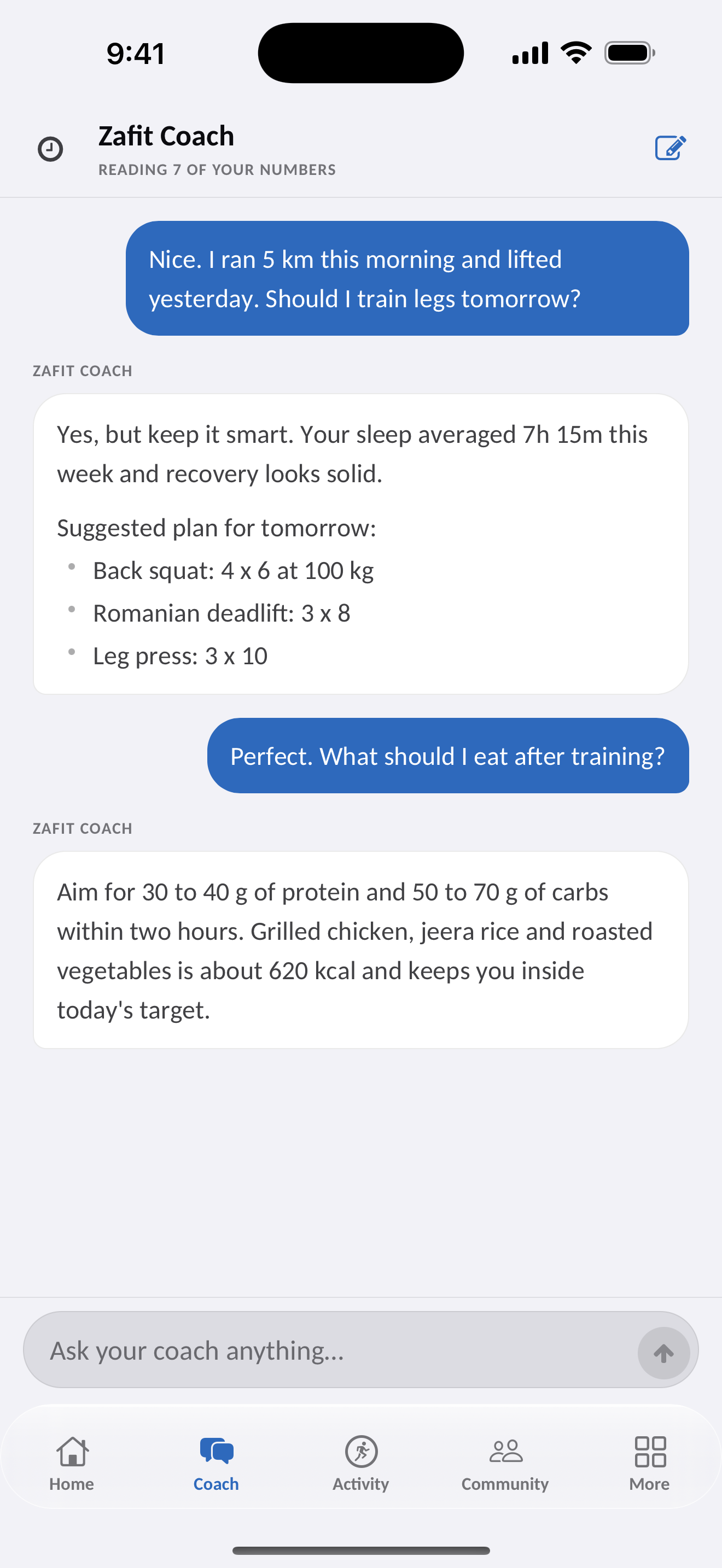
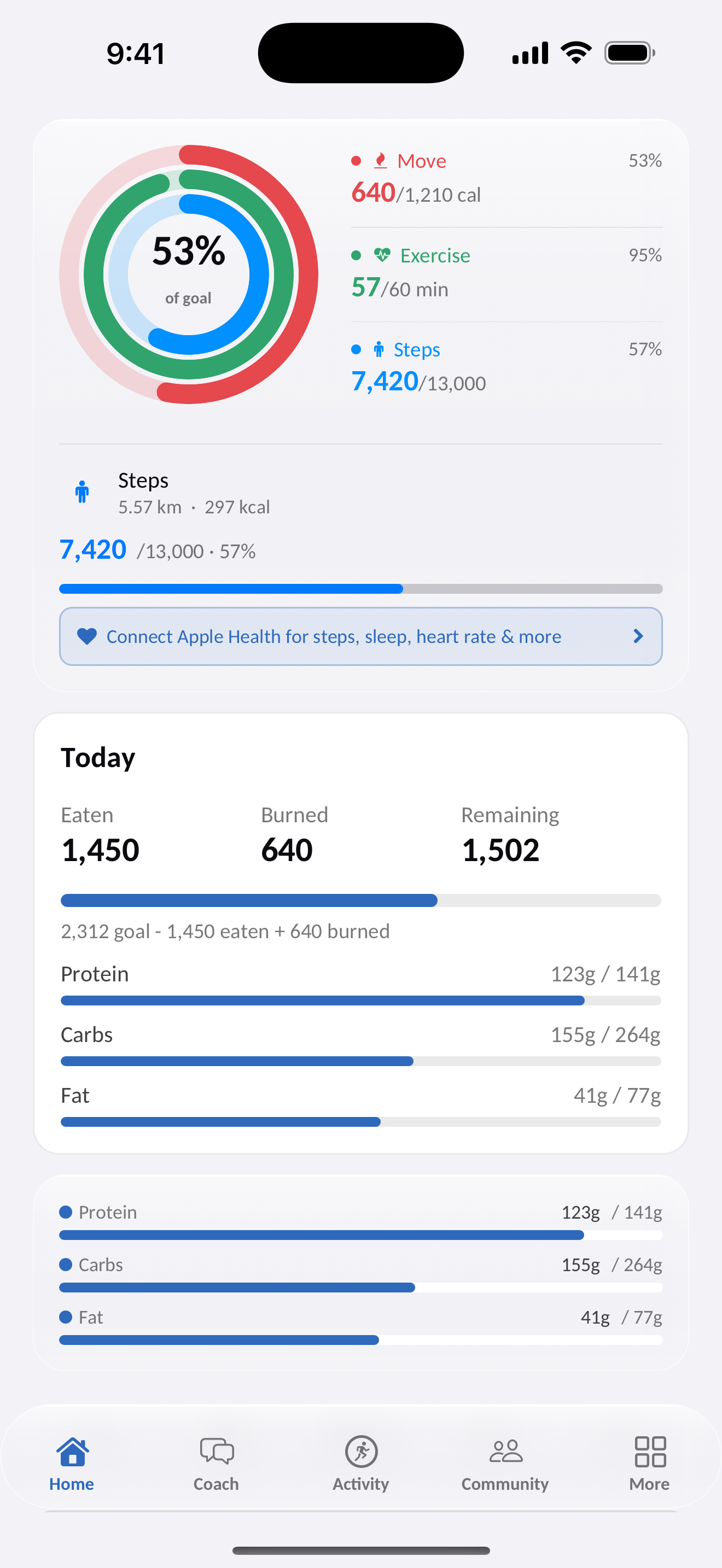
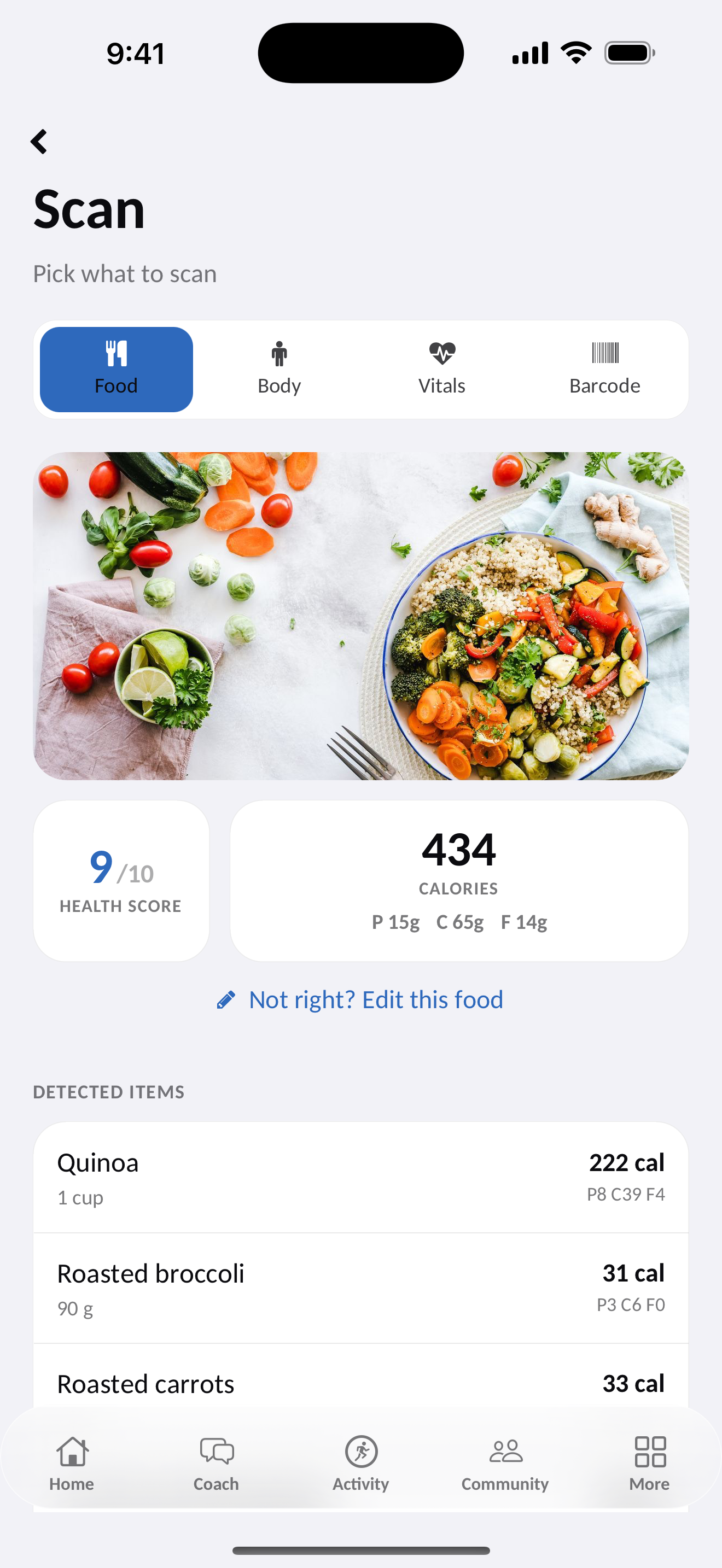
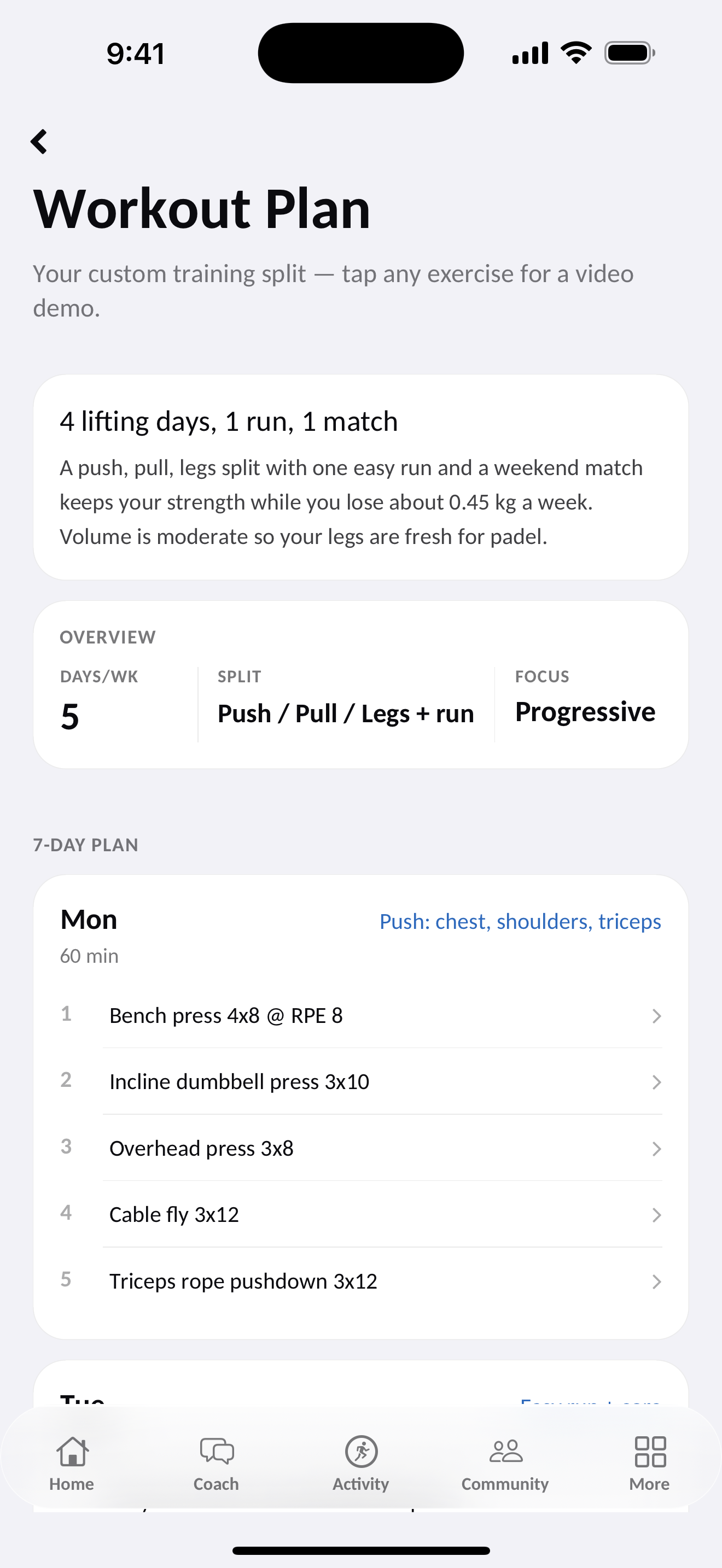
Coach, food scanner, body scan, 20+ personalized plans and voice doctor consults — in one private app.
Zafit ties your food, training, sleep, recovery, labs and skin into a single daily plan — and adapts it as your data changes.
A coach that remembers your goals, bloodwork, sleep and training — and adapts your plan in real time, 24/7.
Point your camera to identify food and read calories and macros, or scan your body composition — no wearables required.
Workout, meal, sleep, recovery and supplement plans generated from your data and the equipment you actually own.
Talk naturally to AI specialists across 12 fields. They listen, can see your camera, give specific guidance and remember past consults.
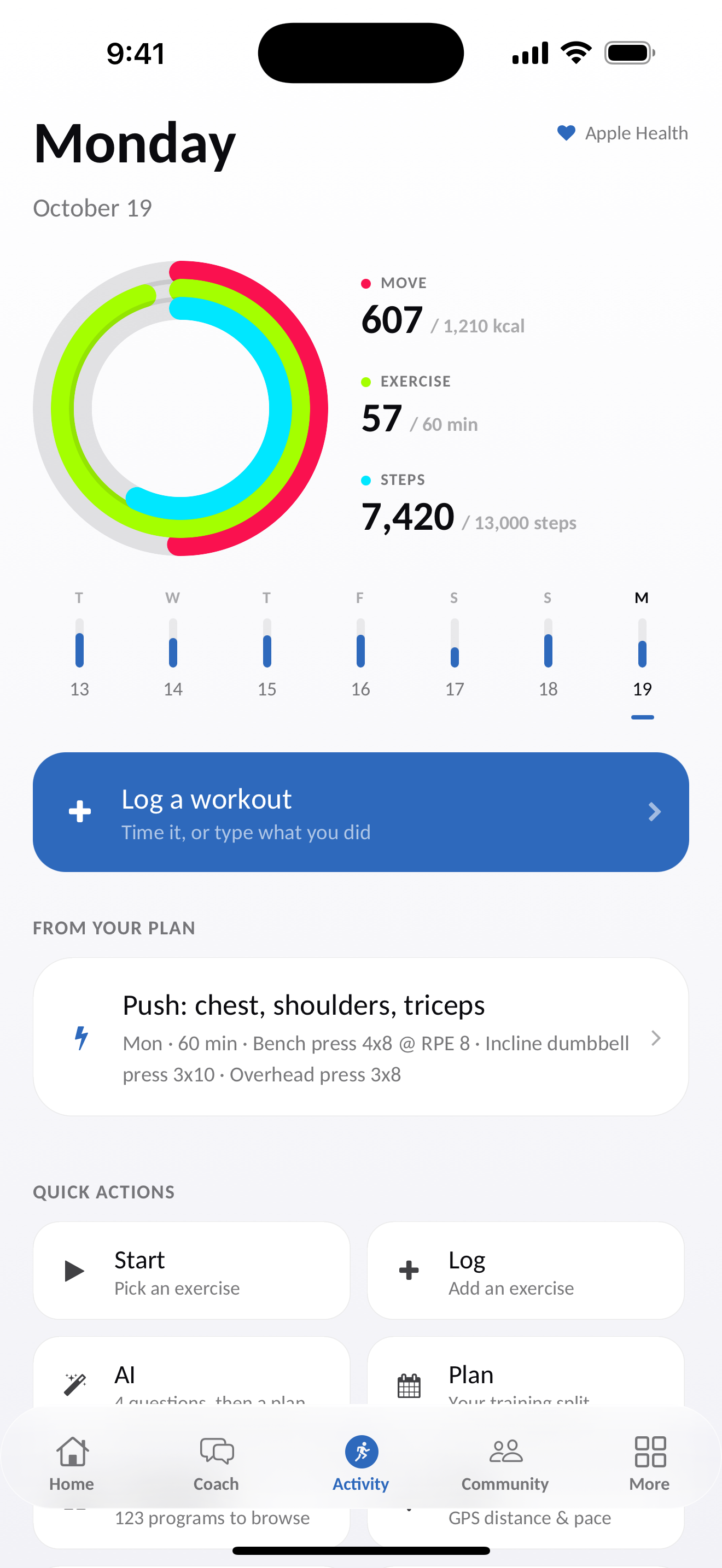
Apple Health sync for Move, Exercise and Stand — your daily activity, right alongside your nutrition and coaching.
Macro tracking, food scanning and meal planning with targets that adjust to your sleep, workouts and goal.
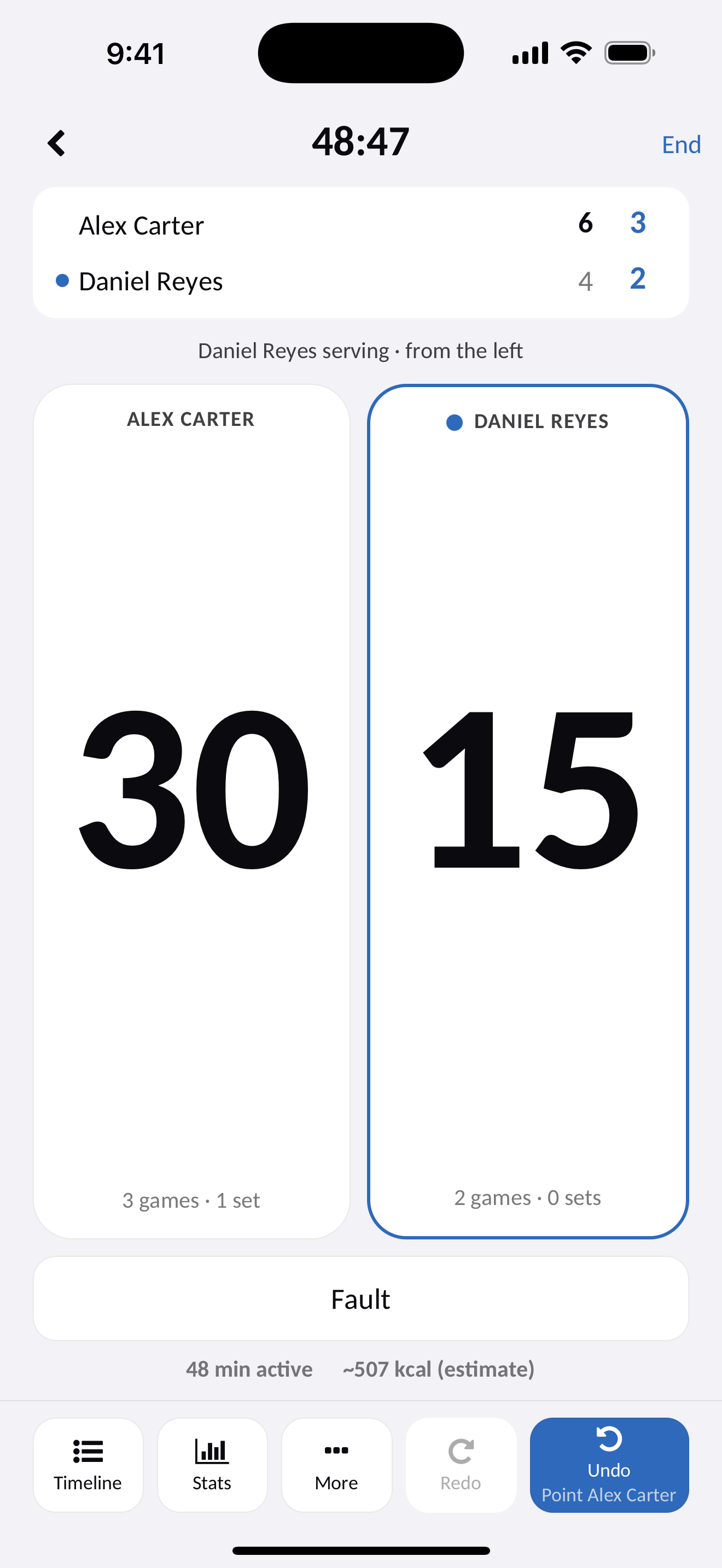
Equipment-specific routines with form guidance, strength logs, sets and personal records — synced to Apple Health.
Sleep tracking, HRV-based recovery and wind-down rituals so your training matches what your body can actually handle.
Log 30+ biomarkers with healthy ranges, trends and plain-English insights that feed straight into your plan.
Personalized skin-health tracking and routines, built from photos and your wider health picture.
Privacy is the foundation. Your health data stays yours — we never sell it and we never run ads against it.
Build the small daily wins — water, steps, fasting windows and more — with streaks that keep you coming back.
A quick onboarding captures your goals, the equipment you own, your age and how you live. No wearable, no setup headache.
Snap your meals, run a body scan, and sync activity from Apple Health. Everything lands in one place automatically.
Zafit generates your daily plan and adjusts it as your data changes — meals shift with sleep, workouts shift with your scans.
Most apps forget you the moment you close them. Zafit's coach carries your full context — every scan, meal, night of sleep and lab result — so its advice is about you, not a generic average.
Point your phone at a plate to identify the food and estimate calories, macros and micronutrients — with healthier swaps tied to your goal. Scan your body to read composition without a single wearable.
Start a voice consult and talk naturally to an AI specialist across 12 fields. They listen, can see through your camera, give specific guidance, and remember your past sessions.
…and four more specialties — all with cross-session memory.
Sustainable deficits that protect muscle, with a coach that adjusts the moment progress stalls.
Equipment-specific training, smart protein targets and form guidance — no guesswork between sets.
From PCOS and glucose to sleep, recovery and bloodwork — one plan that respects the whole picture.
Practical, evidence-based reads — the same thinking Zafit's coach uses every day.
Fat loss comes down to one principle: over time, you have to eat slightly less energy than you burn. But the way most people apply it — slashing calories as hard as possible — is exactly why it fails.
Start with maintenance. Your maintenance calories are what you eat to hold your current weight. A sensible cut is roughly 15–20% below maintenance, which for most people is a deficit of 300–500 kcal per day. That pace loses about 0.25–0.5 kg of fat per week while keeping your energy, training and mood intact.
Protect your muscle. In a deficit your body will burn whatever it can — including muscle — unless you give it two reasons not to: enough protein (see guide 02) and resistance training at least twice a week. Muscle is what keeps your metabolism high and your body looking lean rather than just smaller.
Expect plateaus. As you lose weight you burn fewer calories, so progress slows. That's normal, not failure. The fix is small — trim another 100–150 kcal, add a few thousand steps, or hold steady for a week. This is exactly where an adaptive coach earns its keep: it re-reads your trend and adjusts before you spiral.
Protein is the one macro almost everyone under-eats — and the one that makes the biggest difference to how a diet feels and looks.
The simple target: aim for roughly 1.6–2.2 grams of protein per kilogram of bodyweight per day if you're training. For an 80 kg person that's about 130–175 g. If you're in a fat-loss phase, lean toward the higher end — protein protects muscle and keeps you full.
Why it works. Protein has the highest thermic effect of any macro (your body burns more digesting it), it's the most satiating gram-for-gram, and it's the raw material your muscles rebuild from after training. Hit your protein and the rest of your diet gets easier almost automatically.
Make it practical. Spread it across 3–4 meals, anchor each meal with a clear protein source, and don't stress about perfect timing. A photo scan that flags "you're 40 g short today" is worth more than any complicated schedule.
"You can't build muscle and lose fat at the same time" is one of fitness's most stubborn myths. For most people — especially beginners, those returning after a break, or anyone carrying extra fat — you absolutely can. It's called body recomposition.
The three levers. Recomp works when you combine a small calorie deficit, high protein, and progressive resistance training. The deficit pulls energy from fat stores; the protein and training tell your body to keep — and slowly add — muscle with that energy.
Go slow on purpose. Recomp is gradual. The scale may barely move for weeks while your body fat drops and your lean mass rises. This is exactly why scale weight alone is a terrible progress metric — and why a body scan that separates fat mass from lean mass tells the real story.
Train with intent. Pick compound movements, log your sets, and aim to add reps or weight over time. You don't need to live in the gym — two to four focused sessions a week, progressing steadily, will recomposition your body over a few months.
A body scan turns a single number — your weight — into the three numbers that actually matter. Here's how to read them.
Body fat % is the share of your weight that's fat. It's the truest measure of "leanness." Watching this fall while your weight holds steady is the clearest sign a recomposition is working.
Lean mass is everything that isn't fat — mostly muscle and water. You want this to hold or rise during a fat-loss phase. If it's dropping fast, you're likely cutting too hard or under-eating protein.
Weight is still useful, but only in context. Water, food and time of day swing it by a kilo or more day to day. That's why Zafit shows you the trend over weeks rather than asking you to react to a single morning's number.
Read together, these three tell you whether you're losing the right kind of weight — and that's the difference between getting smaller and getting in shape.
You don't get fitter in the gym — you get fitter recovering from it. Training is the stimulus; sleep and recovery are when your body actually adapts.
Sleep is non-negotiable. Under-sleeping raises hunger hormones, lowers willpower, blunts muscle recovery and tanks training performance. Most adults need 7–9 hours. If fat loss has stalled despite a good diet, your sleep is the first place to look.
Recovery is individual. Heart-rate variability (HRV) is a useful window into how recovered you are. A low-HRV morning is a signal to train lighter or prioritise rest — pushing hard anyway just digs the hole deeper.
Build a wind-down. Dim lights, screens away, a consistent bedtime. Small rituals compound. When Zafit nudges your workout intensity based on last night's sleep, this is the science it's acting on.
Bloodwork is the closest thing you have to a dashboard for what's happening inside your body — and tracking it over time turns one-off numbers into real insight.
Beyond "normal." A result inside the lab's reference range isn't always optimal for you. Trends matter: a marker drifting year over year can flag a problem long before it crosses into "abnormal."
Markers worth knowing. Lipids tell you about heart health, fasting glucose and HbA1c about blood-sugar control, ferritin and vitamin D about energy and recovery, and a basic hormone panel about training and mood. You don't need to memorise them — you need them tracked and explained.
Close the loop. Bloodwork is most powerful when it changes what you do. Low vitamin D? Adjust supplements and sun. Creeping glucose? Tweak carbs and movement. Zafit reads 30+ biomarkers and feeds them straight into your plan, so a lab result becomes an action — not a PDF you forget.
"The food scanner is unreal. I just take a photo and it's logged. I've stuck with tracking longer than ever."
"Talking to a voice consult while I cook dinner changed everything. It feels like having a specialist on call."
"Finally one app instead of six. Body scan, workouts, meals, bloodwork and a coach — and my data stays private."
Free to download and use. Premium unlocks the AI coach, body scan, voice consults and full plan generation.
Prices may vary by region and are billed through the App Store. Cancel anytime.
I built Zafit because staying healthy shouldn't mean juggling six different apps and handing over your data to do it. One private companion that actually remembers you — that's the whole idea.